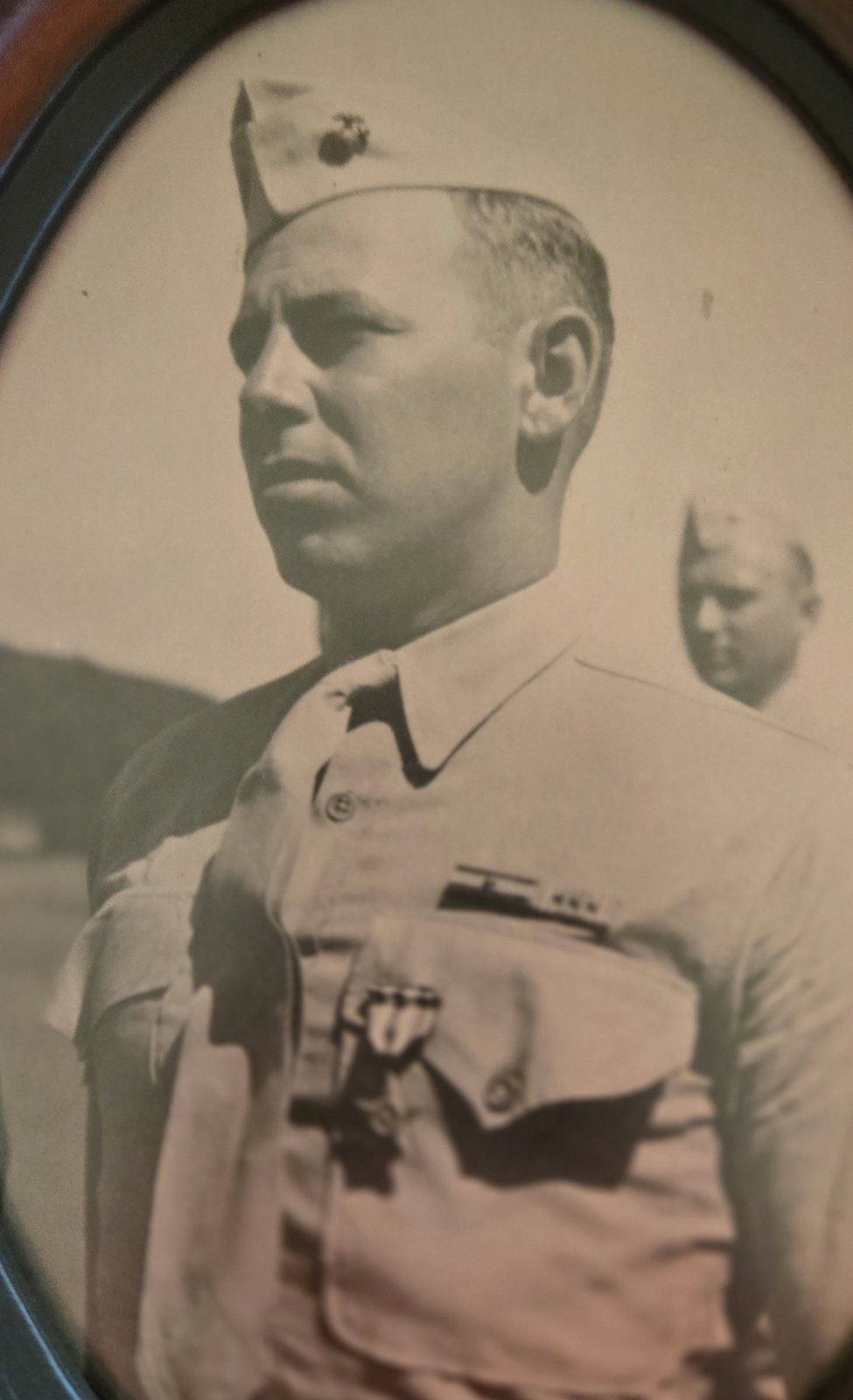
Cloyce Lincoln Fruth was born on February 12, 1922, in Flatrock Township, Ohio, the son of Walter H. Fruth and Luella Knipp Fruth. Luella was the sister of Howard’s father, Earl Knipp, so Cloyce and Howard were first cousins (see the family tree). Cloyce entered the service from Napoleon, Ohio. While Howard was at sea on the USS Fletcher, his cousin Cloyce was a Marine in the 23rd Marine Regiment of the 4th Marine Division. As a corporal and machine gun section leader in Company E, 2nd Battalion, 23rd Marines, he was awarded the Silver Star for his actions on Iwo Jima on March 8, 1945, one of the hardest-fought battles in the history of the Marine Corps.
The 4th Marine Division
The 4th Marine Division was formed in 1943 at Camp Pendleton, California, and was the first Marine division to go into combat directly from the United States. In thirteen months it made four assault landings:
- Feb 1944Roi-Namur, Kwajalein Atoll, Marshall Islands.
- Jun – Jul 1944Saipan, Mariana Islands, landing June 15.
- Jul – Aug 1944Tinian, Mariana Islands, landing July 24.
- Feb – Mar 1945Iwo Jima, Volcano Islands, landing February 19. The island was declared secure on March 16.
Each regiment was built around three rifle battalions. A machine gun section, usually two squads and two guns, was led by a sergeant or corporal. On the attack, the section leader picked the gun positions, set their fields of fire to cover the riflemen as they moved, and kept the guns supplied and firing, which meant moving in the open under fire while the gunners stayed down.
Where his path crossed Howard’s
In January 1944 the Fletcher was one of the destroyers screening the transports that carried the 4th Marine Division. She joined the convoy off Oceanside, California, on January 4, and on January 13 the task force, TF 53, sailed for Hawaii and on to the Marshall Islands, where the division landed on Roi and Namur on February 1. If Cloyce was in the division by then, Howard’s ship was guarding his.
A year later the cousins were again in the same war at the same moment. On February 14, 1945, the Fletcher was hit by a shore battery off Corregidor (see the Corregidor fragment). Five days later, and about 1,500 miles to the northeast, the 4th Marine Division went ashore on Iwo Jima.
Iwo Jima
Iwo Jima is a small volcanic island, about eight square miles, roughly 660 miles south of Tokyo. Its airfields were wanted as an emergency landing field for B-29s returning from Japan and as a base for fighter escorts. About 21,000 Japanese defenders under Lt. Gen. Tadamichi Kuribayashi were dug into a network of tunnels, caves and concrete bunkers, and very few of them were seen until the Marines were on top of them.
On the morning of February 19, the 23rd Marines landed on Yellow Beaches 1 and 2, near the middle of the southeast shore. The beaches were steep terraces of loose black volcanic ash that men and vehicles sank into. By the end of the first day the regiment had pushed to the edge of Airfield No. 1, under mortar and artillery fire from the high ground to the north and from Mount Suribachi to the south.
From late February into early March the 4th Marine Division fought through the area the Marines named the Meat Grinder: Hill 382, the Amphitheater, Turkey Knob and the village of Minami, a maze of interlocking positions that took about two weeks to break. The division lost more than 9,000 men killed and wounded on Iwo Jima. Admiral Chester Nimitz wrote of the battle, “Among the Americans who served on Iwo Island, uncommon valor was a common virtue.”
The Silver Star: March 8, 1945
By the second week of March the 4th Marine Division had fought its way through the Meat Grinder and was pressing the last Japanese defenders toward the island’s eastern shore. On March 8, the Japanese struck back with a heavy counterattack against the division’s lines.
Cloyce was a corporal leading a machine gun section in Company E. His citation tells what happened:
“The President of the United States of America takes pleasure in presenting the Silver Star to Corporal Cloyce L. Fruth (MCSN: 448332), United States Marine Corps Reserve, for conspicuous gallantry and intrepidity while serving as a Machine Gun Section Leader of Company E, Second Battalion, Twenty-third Marines, FOURTH Marine Division, in action against enemy Japanese forces during the assault on Iwo Jima, Volcano Islands, 8 March 1945. When the other members of his section had become casualties during a heavy enemy counterattack, Corporal Fruth single-handedly operated two light machine guns and, by moving back and forth between the two guns despite heavy hostile fire, kept two sectors which were not otherwise covered, under fire, and through his courageous actions, he greatly aided his platoon in repulsing a hostile counterattack, and his devotion to duty throughout was in keeping with the highest traditions of the United States Naval Service.”
— Commanding General, Fleet Marine Force Pacific, Serial 44534
The Silver Star is the third-highest decoration for valor in combat in the U.S. armed forces.
Called back for Korea
Cloyce stayed in the Marine Corps Reserve after the war. When the Korean War began, reservists were called back to active duty, and Cloyce served again from October 26, 1950, to May 5, 1951. Where he served during those months is not yet known.
This is a work in progress. The Hall of Valor database lists one Silver Star for Cloyce; family accounts mention a second, which we are trying to confirm from his official records. If you have photographs, letters or other records, or knew Cloyce or served with the 23rd Marines, we would love to hear from you.
Sources
- Silver Star citation, Cpl. Cloyce L. Fruth, Hall of Valor, Military Times
- “4th Marine Division (United States),” Wikipedia
- “23rd Marine Regiment (United States),” Wikipedia
- “Battle of Iwo Jima,” Wikipedia
- Lt. Col. Whitman S. Bartley, Iwo Jima: Amphibious Epic, U.S. Marine Corps Historical Section, 1954.
- Dictionary of American Naval Fighting Ships, “Fletcher I (DD-445),” Naval History and Heritage Command
- Map drawn for this site from Natural Earth coastline data and the landing-beach plan in Bartley (1954).
- U.S. Social Security Administration and Department of Veterans Affairs records for Cloyce L. Fruth (birth, parents and 1950–51 service dates), as indexed at sortedbyname.com.
- Family recollections.