About this site
About the Knipp Family Story
Where these stories came from, who gathered them, and the many people who helped.
This site began with a memorial plaque for Howard Knipp at the National Museum of the Pacific War in Fredericksburg, Texas, whose QR code brings visitors here. See the plaque and the memorial bricks on Howard’s page →
Where the story came from
The pieces of this story came from four continents: archives, museums, wreck sites, newspapers, and above all people who kept letters, photographs and memories and were generous enough to share them.
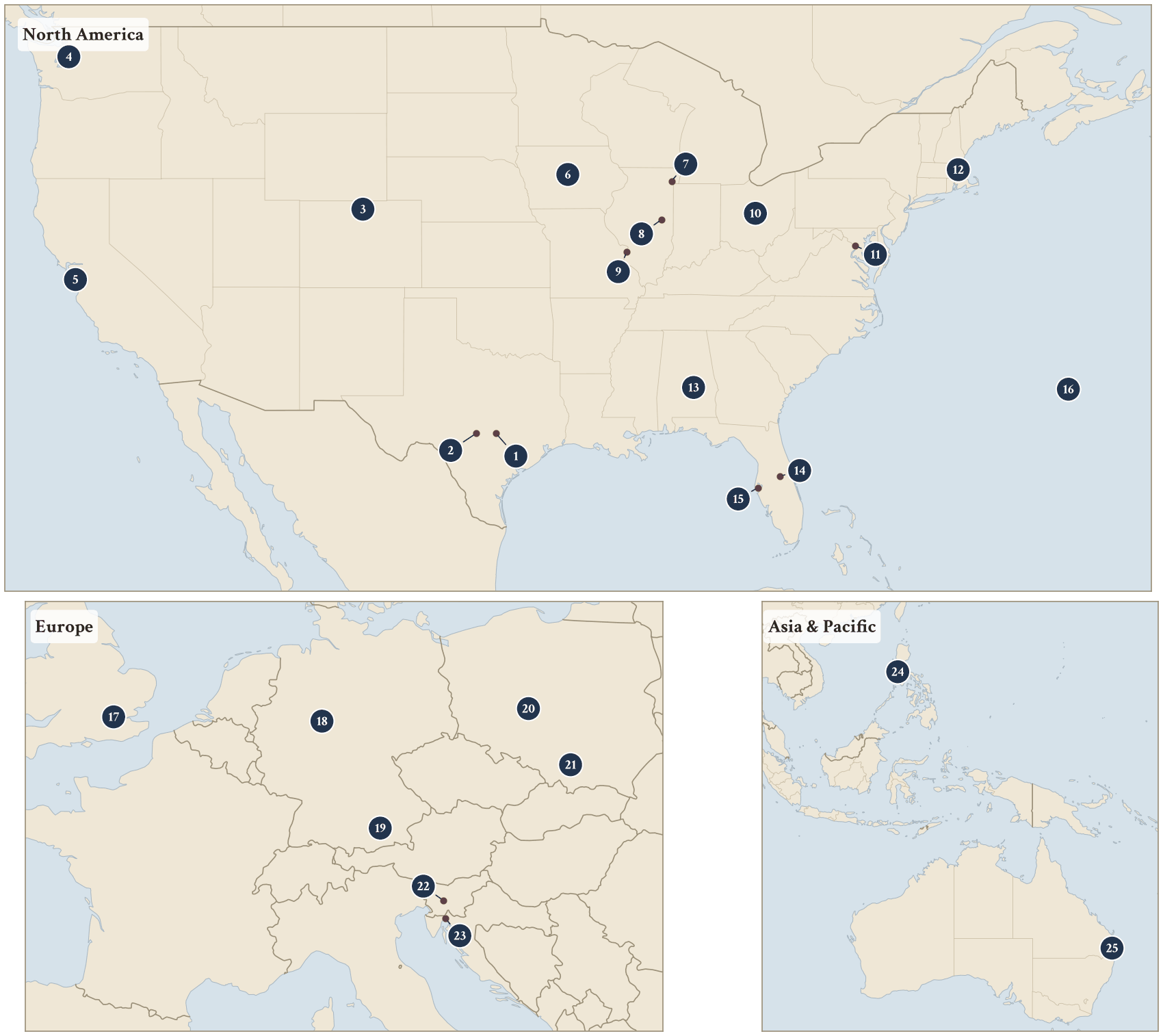
- 1 Austin, Texas Larry’s research, measurements and 3D scans; Dan Digre, son of Cliff Digre.
- 2 Fredericksburg, Texas The National Museum of the Pacific War: Howard’s plaque and the memorial bricks.
- 3 Fort Collins and Crown Point, Colorado Brad Hoopes and Remember and Honor, with Howard’s video interview; Colorado State University’s Morgan Library; the Crown Point B-17 and its bomb shackle; the Stormy Peaks B-17 above Pingree Park.
- 4 Seattle, Washington Bruce Magnuson’s collection and memories of the evaders; Margie Nicosia.
- 5 Santa Clara County, California Records of Mitchell Pyzyna.
- 6 Story City, Iowa The Munsen family museum.
- 7 Chicago, Illinois The Pyzyna family; the Acme photograph of Elaine; Cook County and census records.
- 8 Urbana, Illinois University Laboratory High School, for Julian Knipp.
- 9 St. Louis, Missouri The National Personnel Records Center.
- 10 Ohio Howard’s family, and Dorothy’s parachute-silk dresses.
- 11 Washington, D.C., and College Park, Maryland The National Archives, the Naval History and Heritage Command, the Library of Congress, the U.S. Holocaust Memorial Museum and the American Institute of Physics.
- 12 Medford, Massachusetts Tufts University’s archives, for Julian Knipp.
- 13 Maxwell Air Force Base, Alabama The Air Force Historical Research Agency: Adam’s Escape Statement.
- 14 Kissimmee, Florida The accident report of March 5, 1945, and a man who was there.
- 15 St. Petersburg, Florida The St. Petersburg Times story of Adam’s wings.
- 16 Bermuda Bernews, for Hank Pyzyna and U-505.
- 17 London, England The Imperial War Museums; Fitzroy Maclean’s Eastern Approaches.
- 18 Bad Arolsen, Germany The Arolsen Archives, for Stanisław Tarczyński.
- 19 Munich and Dachau, Germany The Dachau Memorial archive and the Lagergemeinschaft Dachau.
- 20 Kalisz, Poland Stanisław Tarczyński’s letters.
- 21 Kraków, Poland The 2016 gathering where Jerry Whiting met Radovan Živanović.
- 22 Ljubljana and Postojna, Slovenia The Slovene Partisans’ 1946 list of rescued airmen; Postojna Cave.
- 23 Rijeka and Gorski Kotar, Croatia Radovan Živanović and his wreckage and crash maps; Podkilovac, Gerovo and the memorial plaques, visited by the family in 2025.
- 24 Corregidor, Philippines The Corregidor Historic Society’s research on the guns that hit the Fletcher.
- 25 Brisbane, Australia Paul Whitman, editor of Corregidor Then and Now.
Get in touch
If you knew Howard, served on or have family from the USS Fletcher or the USS Rigel, or have photographs or stories about Adam, Cloyce or Julian, we would love to hear from you.
larryk [at] knippfamilystory [dot] com
About the researcher
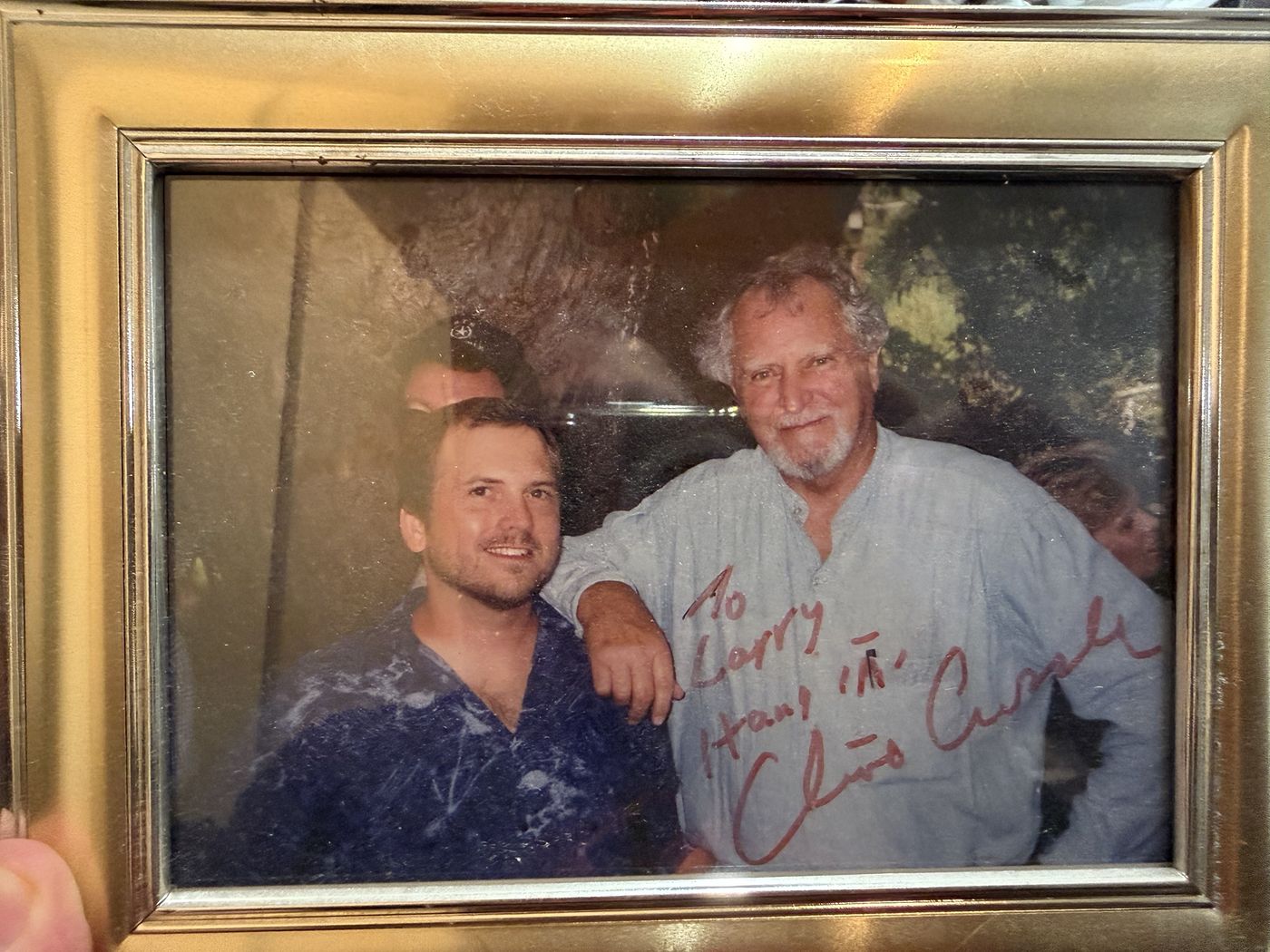
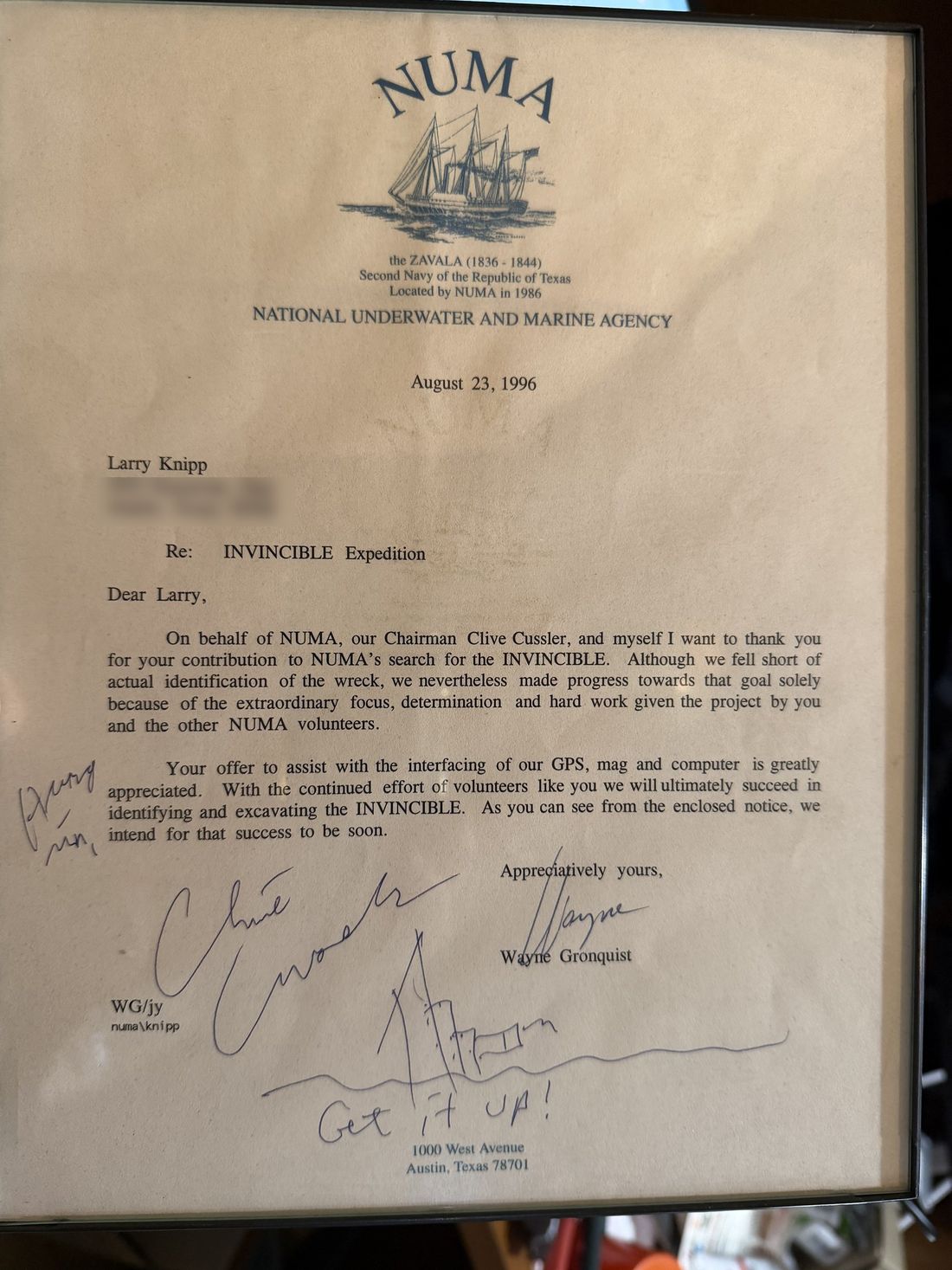
Larry Knipp, Howard and LaVerne’s son, has been drawn to lost ships and lost history for a long time. In 1996 he volunteered with NUMA, the National Underwater and Marine Agency, founded by the adventure novelist Clive Cussler, on its search off Galveston for the Invincible, a schooner of the Navy of the Republic of Texas lost there in 1837. A PADI-certified Divemaster, Larry served as a safety diver on the expedition. As an electrical engineer, he also offered to help interface the search team’s GPS, magnetometer and computer.
The water came early: he grew up with a river at the bottom of his backyard. Growing up on the Maumee in Napoleon, Ohio →
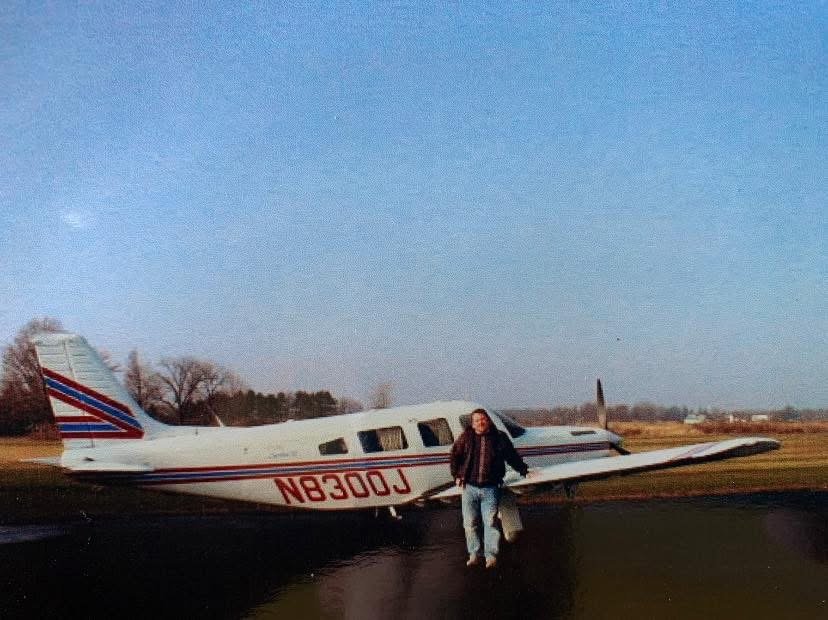
Long before he began following Adam’s trail, Larry found a piece of a B-17 himself. Around 1992, hiking in the mountains above the Cache la Poudre canyon west of Fort Collins, Colorado, he came across the scattered wreckage of a Flying Fortress and brought home a bomb shackle. The story he heard locally was of a training crew that flew into a canyon and could not climb or turn out of it. The records tell a story close to that one. Just before midnight on June 13, 1944, a B-17F on a night training flight from Rapid City Army Air Base in South Dakota, some 70 miles off course, met the forested slope below Crown Point at about 10,200 feet. The pilot saw the mountainside ahead and pulled up at full power, and the bomber’s belly struck the trees as the nose came up; investigators believed that pull-up saved lives. Four of the ten men aboard were killed: the pilot, Drury Holt, the co-pilot, Doyle J. Hall, Timothy O. Hurst and Daniel E. Conway. Two of the survivors, Sgt. Don Jacobs and Cpl. Leroy Faigin, walked some fourteen hours to find help, and the next day an Army doctor, Lt. Amos Little, parachuted in to treat the injured. The wreckage still lies in the Comanche Peaks Wilderness.
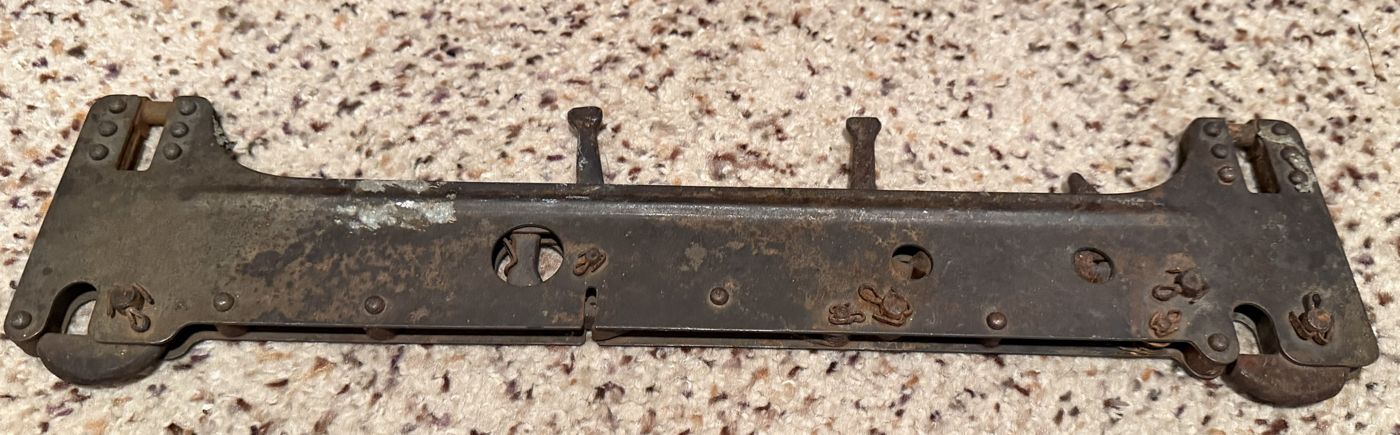
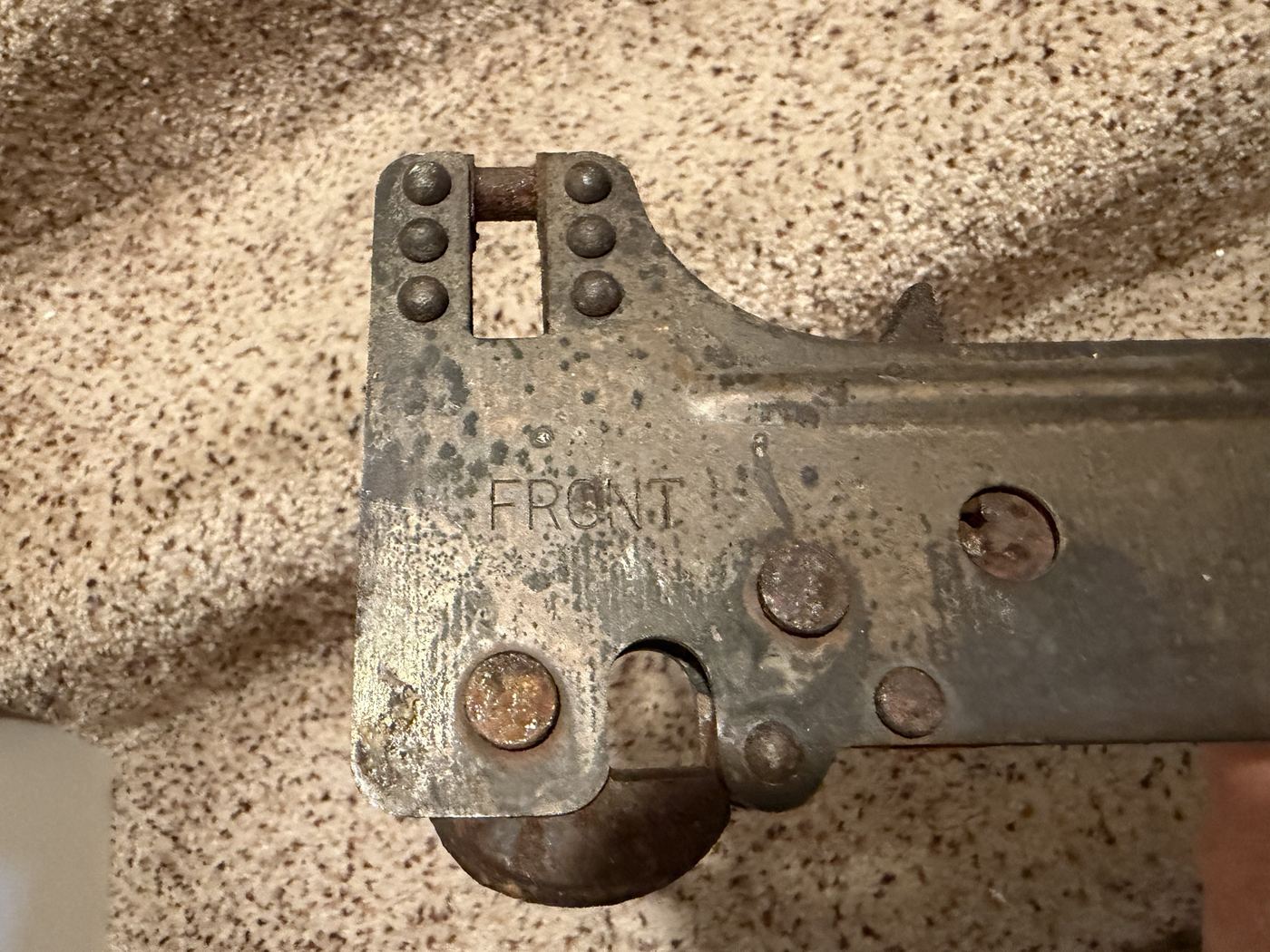
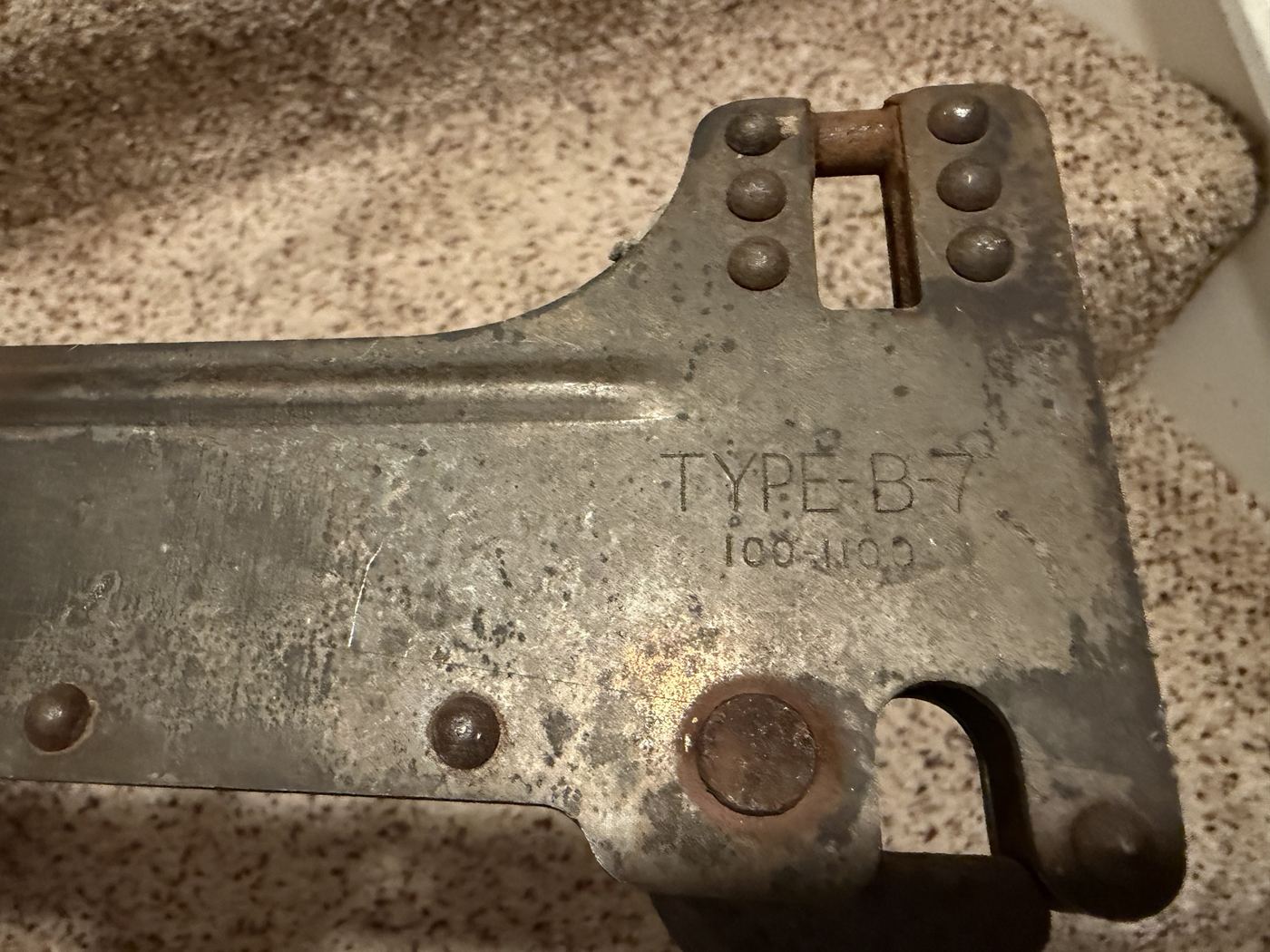
Adam’s bombs hung from shackles exactly like this one. When the Norden bombsight reached its release point, or Adam pressed the release on the lead bombardier’s signal, these were the hooks that opened.
The war at home: training accidents
Larry has hiked to a second B-17 wreck in the same mountains, on the north side of Stormy Peaks above Pingree Park, a few miles from Crown Point. On the night of October 18, 1943, B-17F 42-6042 of the 600th Bomb Squadron, 398th Bomb Group, was on a navigation training flight from Rapid City Army Air Base to Denver when it drifted off course in a snowstorm and struck the mountain at about 10,500 feet, right at timberline. A rancher’s wife some seven miles away heard the bomber pass low overhead and then a “terrific explosion,” and the fire it started had to be put out by a Forest Service crew. All eight men aboard were killed: the pilot, 2nd Lt. Richard N. Creamer; the co-pilot, 2nd Lt. Joseph R. Arnold; the navigator, 2nd Lt. Warren M. Dean; the bombardier, 2nd Lt. Andrew H. Christensen; S/Sgt. William N. Cook; Sgt. Robert J. Hopkins; Sgt. Carl E. Hamre; and Sgt. Philip M. Doddridge. When Larry reached the site, the impact had stripped the slope down to shattered rock, with pieces of the B-17 scattered among it. A memorial plaque to the crew was placed nearby in 1997.
Both bombers came from the same base, Rapid City, and both were lost at night, off course, in the same stretch of mountains, eight months apart. They were not unusual. According to the Army Air Forces’ own Statistical Digest, between Pearl Harbor and the end of the war there were more than 52,000 aircraft accidents in the United States alone, more than 6,000 of them fatal, and nearly 15,000 airmen were lost in them, without ever leaving the country. Training was dangerous in itself: young crews, worn or new aircraft, night and instrument flying, mountains and weather.
Adam Pyzyna was one of them. He survived 26 combat missions, the loss of his B-17 over Yugoslavia and 45 days behind enemy lines, came home, and was killed on March 5, 1945, when a P-38 taking off at Kissimmee Army Air Field, Florida, struck the B-26 he was landing in. All eight men aboard the two aircraft died. Read Adam’s story →
The same habits of patience, digging and following every lead carried over into the search for Howard’s and Adam’s stories told on this site.
With thanks
First and always, to Larry’s wife, Wanda Molinary, who has been part of this search from the beginning, traveled with Larry to Croatia to see where Adam came down, and has lived with these stories every day.
A special thanks to Wanda and to Larry’s family (Veronica, Gregory and Mitchell) for putting up with him through all of it: the years of travel, and the many trips that somehow always included a few more museums, one more ship, another air show and one more historic site, as the research took them around the world. Thank you for your patience, your company and your love.
To the family who shared their photo albums, papers and memories: Dennis Pyzyna, for Hank’s Navy discharge, photographs and story; Michelle Pyzyna, for her father Mitch’s photographs, the family tree and the records that filled in his and Lorissa’s lives; David Swock, for his mother Marian’s memories of the Pyzyna family; and Chuck Fruth, for the Fruth family’s photographs and records of his father, Cloyce. Every cousin who answered a question or sent a picture is part of this.
To the families of the men who walked out of Yugoslavia with Adam, who have shared their fathers’ stories and their own research as if Adam were one of theirs: the late Bruce Magnuson, son of Cliff Magnuson, the highest-ranking officer of the group of close to 100 evaders, who told us of the evaders’ trek; Bruce Kenney, whose father is among the evaders in the photograph with Tito’s partisans; and Steve Nordwell, whose father, Ernie Nordwell, was rescued by the same Partisans and who found Adam’s name in their records.
To Margaret Nicosia, who kept Bruce Magnuson’s research files together after his passing, so that they would not be lost at auction, and has worked ever since to return what they hold to the airmen’s families. Margaret was among those who sent us the wartime record of Allied airmen rescued by the Slovene Partisans, where Adam’s name appears under March 18, 1944, and she put us in touch with Steve Nordwell. She has searched Bruce’s binders for Adam’s letter and shared the photographs she made of Bruce’s collection.
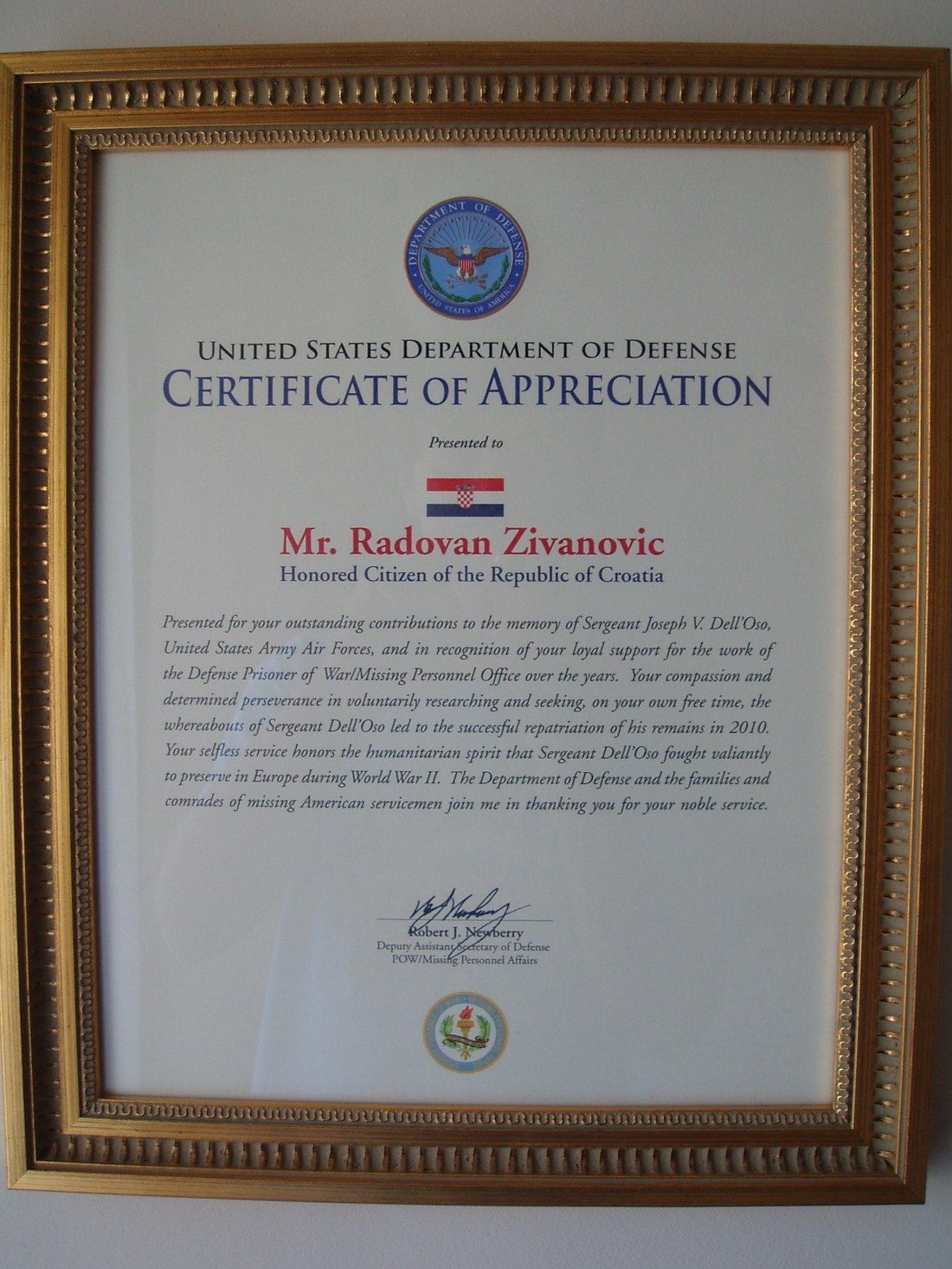
To Brad Hoopes; to Jerry Whiting, a great detective, who put us in touch with Radovan; to Radovan Živanović, whose parts in this story are told below; and to Radovan’s wife, Sandra, for her welcome in Croatia.
To all our fellow searchers and historians, the archivists, researchers and keepers of records who answered a stranger’s letters with patience and generosity, among them the staff of the Dachau Concentration Camp Memorial Site archive, the Arolsen Archives, the National Archives and its National Personnel Records Center, and the many volunteers who transcribe, index and share the records the rest of us depend on.
Our family is deeply grateful to the National Museum of the Pacific War in Fredericksburg, Texas, and the Admiral Nimitz Foundation, for preserving the history of the war in the Pacific and keeping the memories of the men and women who served in it alive in our lives.
And our special thanks to Stephanie Hagee, the museum’s Tributes Director, who helped us create Howard’s memorial plaque and who has helped so many families preserve the memories of their lost heroes.
These stories could not have been told without three men in particular, and the remarkable chain of chance that linked them.
Brad Hoopes
Brad Hoopes, of Colorado, has spent years recording the personal stories of World War II veterans, more than five hundred interviews so far, so that each one is preserved for the veteran’s family and for history. His book Reflections of Our Gentle Warriors collects seventy of them. Brad sat down with Howard in Colorado and recorded his memories of the Navy and the USS Fletcher, and gave the family the interview on DVD. Watch Howard’s interview on his page → Some time after the interview, Larry told Brad about Uncle Adam and asked whether he knew anyone who could help. Brad sent him to his friend Jerry Whiting.
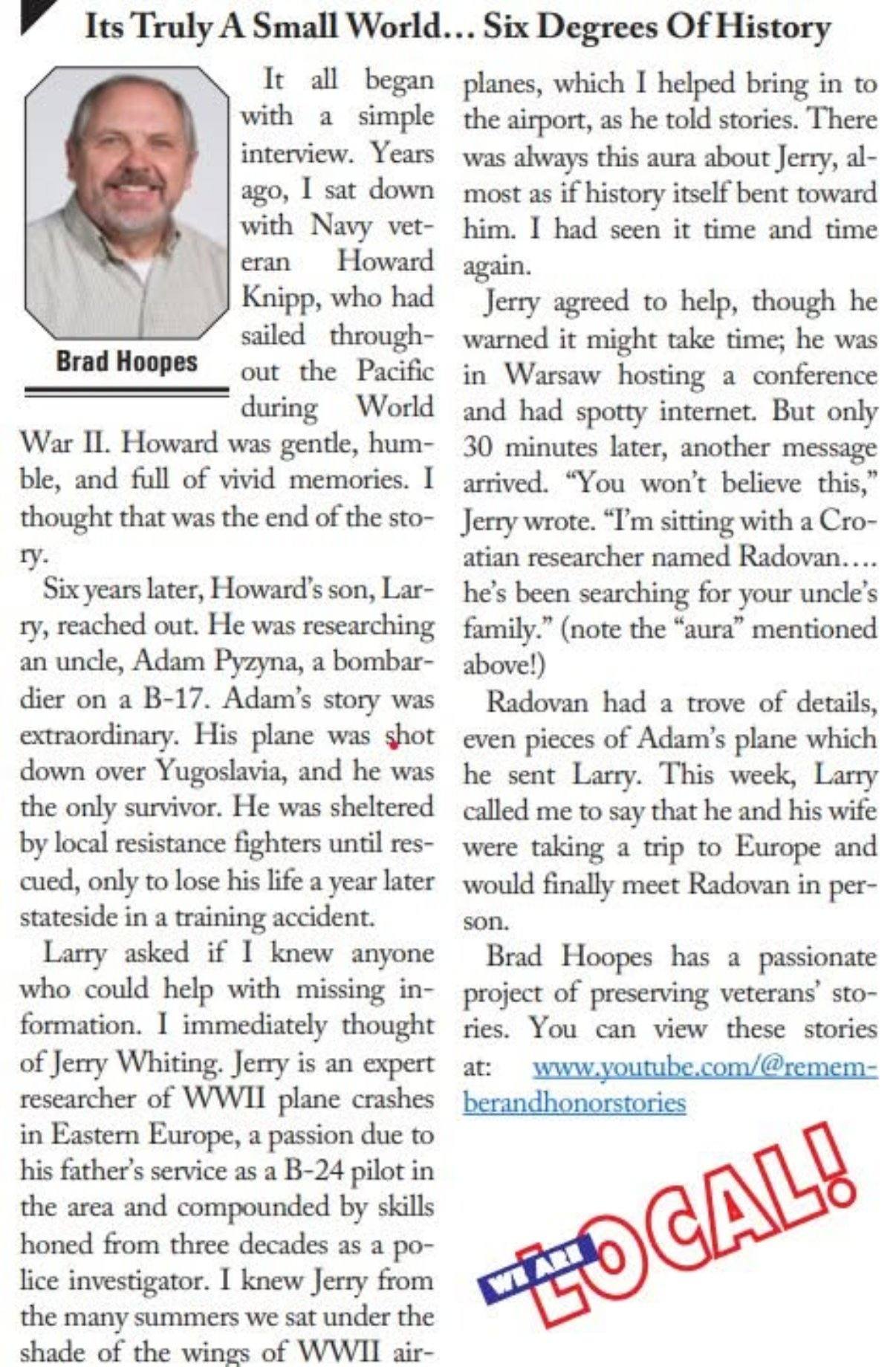
Brad told this part of the story himself in his September 2025 column for the 50 Plus Marketplace newspaper, “Its Truly A Small World… Six Degrees Of History,” written as Larry and Wanda were leaving for Europe to meet Radovan. Brad’s veterans’ interviews can be watched on his Remember and Honor Stories YouTube channel.
Jerry Whiting
Jerry Whiting has long researched American airmen missing from World War II. Larry emailed him on March 30, 2016, asking for help finding out more about Adam. Jerry wrote back the next morning from Kraków, Poland, where he and a friend were hosting a conference on American MIAs. He was relatively certain he could help, he said, but with little access to email it would likely be a couple of weeks before he could get back to Larry. Just a few hours later a second email arrived, full of excitement: he had just met a man who had been to Adam’s crash site.
“This is getting stranger every minute! … After my earlier email I spoke to my Croatian friends. One of them, Radovan, couldn’t believe I was in touch with you. Radovan hoped to find your family. You’ll probably think I’m crazy or making this up, but I’m not. Radovan has many pieces of this B-17 at his house.”
Jerry credits moments like this to what he calls the “story gods.” His email introduced our family to Radovan the same day.
Radovan Živanović
Radovan Živanović of Croatia has spent years searching the mountains of Gorski Kotar and the Croatian coast for the aircraft lost there in World War II. His work has helped identify and recover the remains of many missing airmen, Allied and German alike, along with their aircraft, and has given their families answers they waited decades for. He had already found the wreckage of Adam’s B-17 and had been hoping to find Adam’s family when Jerry put us in touch. He also recovered the tail of the bomber, found the house where the partisans first sheltered Adam, and in 2025 guided us there himself. Read Adam’s story →