What happened
At 1:26 in the afternoon of February 14, 1945, while the Fletcher was covering minesweepers at the entrance to Manila Bay, a hidden shore battery on Corregidor hit her forward, at about frame 25 on the starboard side. The shell burst at the No. 1 gun. Three men were killed in the gun mount and two in the handling room below it, and powder cases caught fire in the No. 1 magazine. Watertender Second Class Elmer C. Bigelow put out that fire without breathing gear; he died the next day and was awarded the Medal of Honor. Eight of the Fletcher’s men died from the hit.
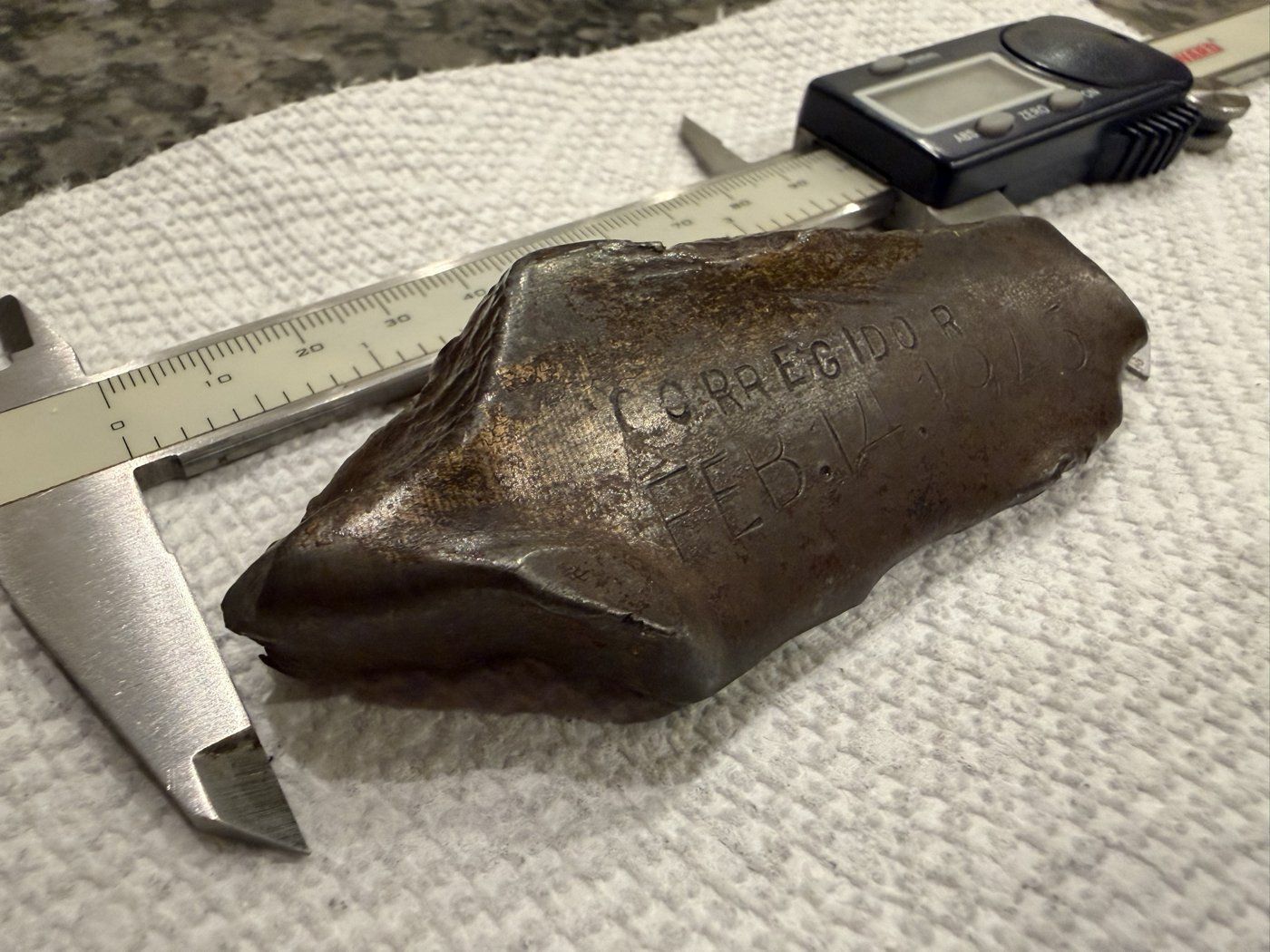
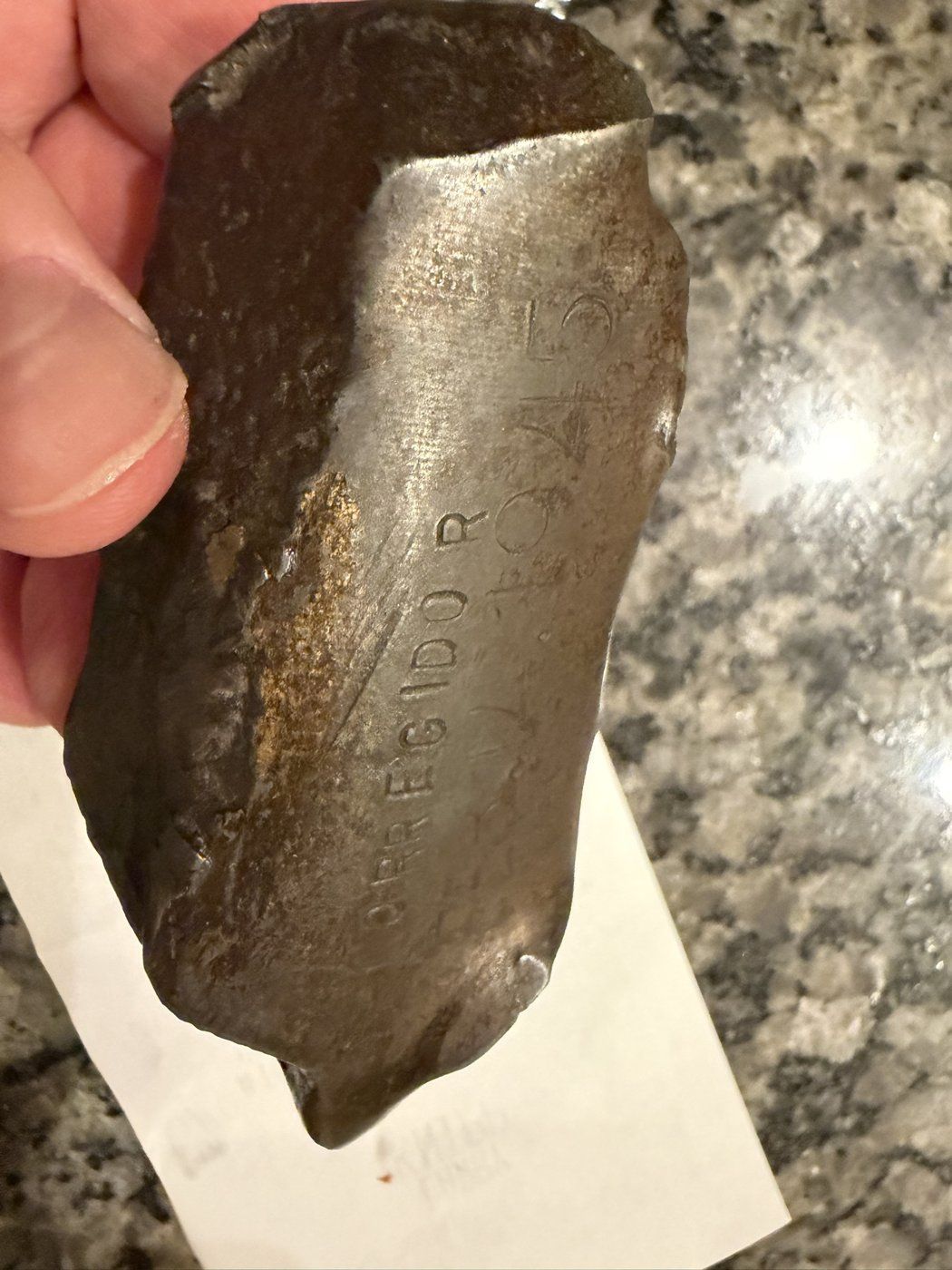
Howard was on the crew that cleaned up afterward. He kept this piece of steel from the damaged area and stamped it, letter by letter, CORREGIDOR FEB. 14 1945. From where the men had been and where it lay, the crew believed it was the fragment that cut through the arm of Storekeeper Third Class Keith Snyder.
Measurements
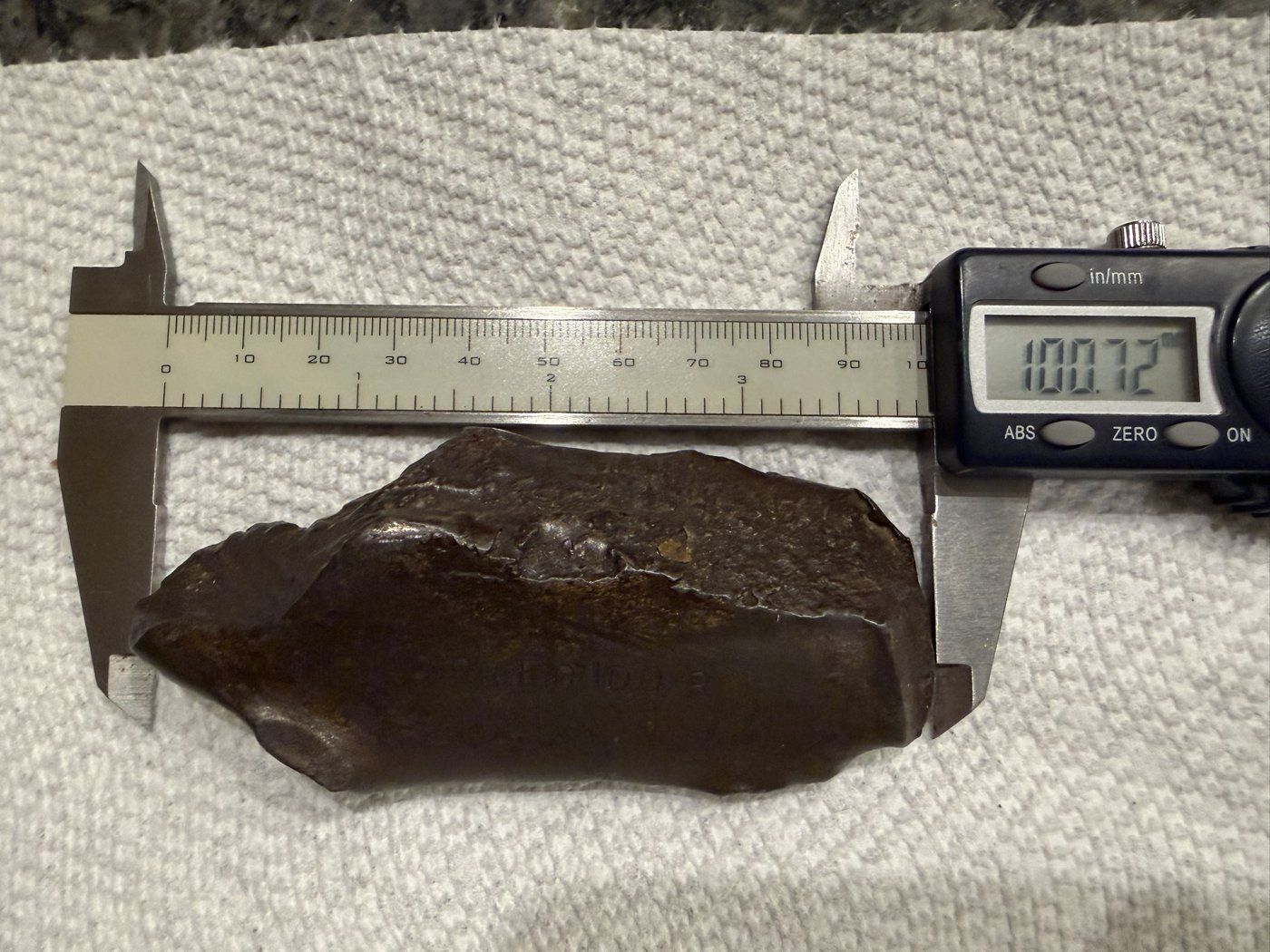
| Length | 100.7 mm (about 4 in) |
|---|---|
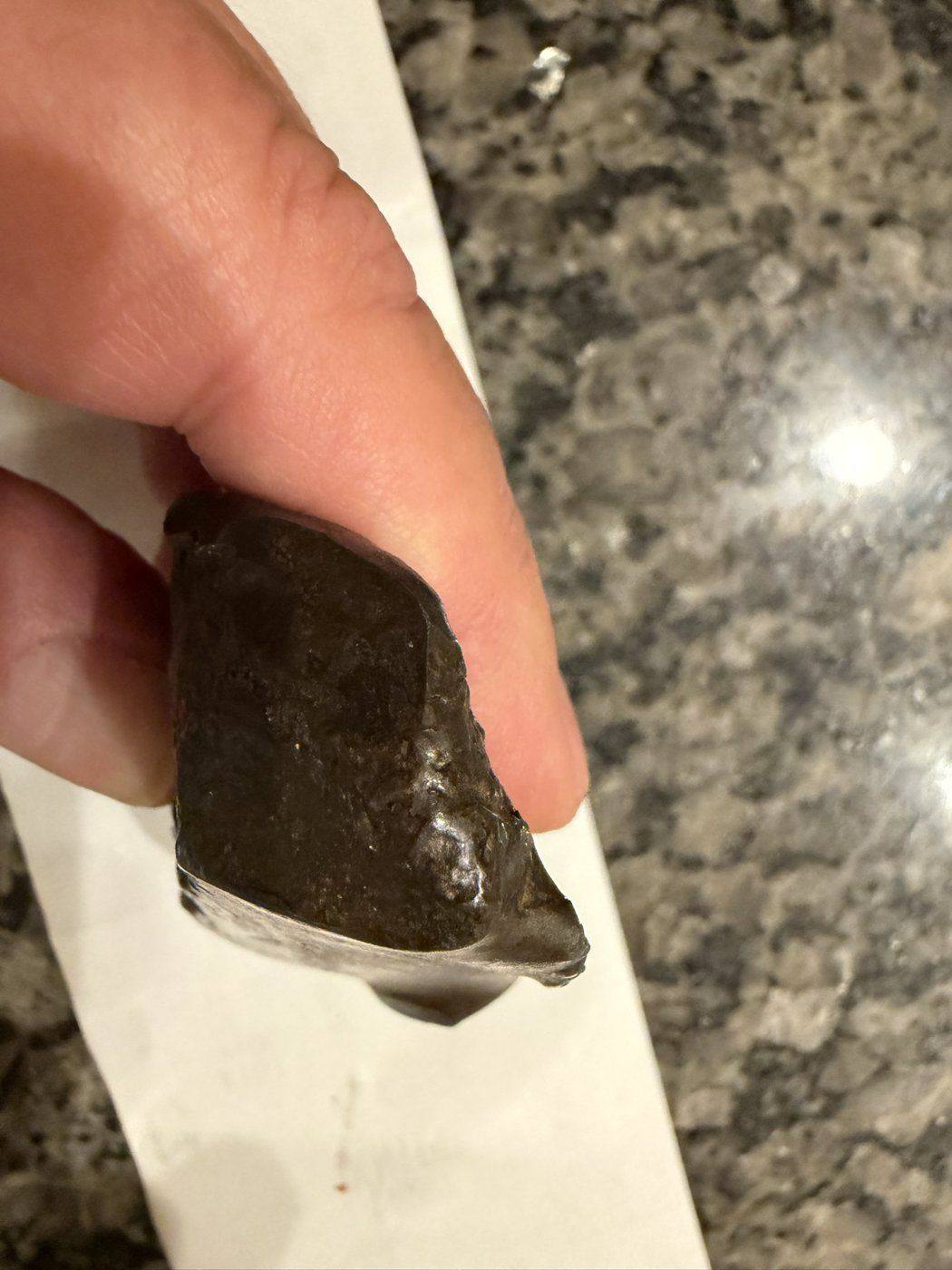
| Thickness | 21 mm (about 0.8 in). On a shell roughly 110–125 mm across, that is a heavy wall, with steel making up roughly a third of the radius. Walls that thick are found toward the base of a shell, or in heavy-walled “common” shells built to punch through before bursting. |
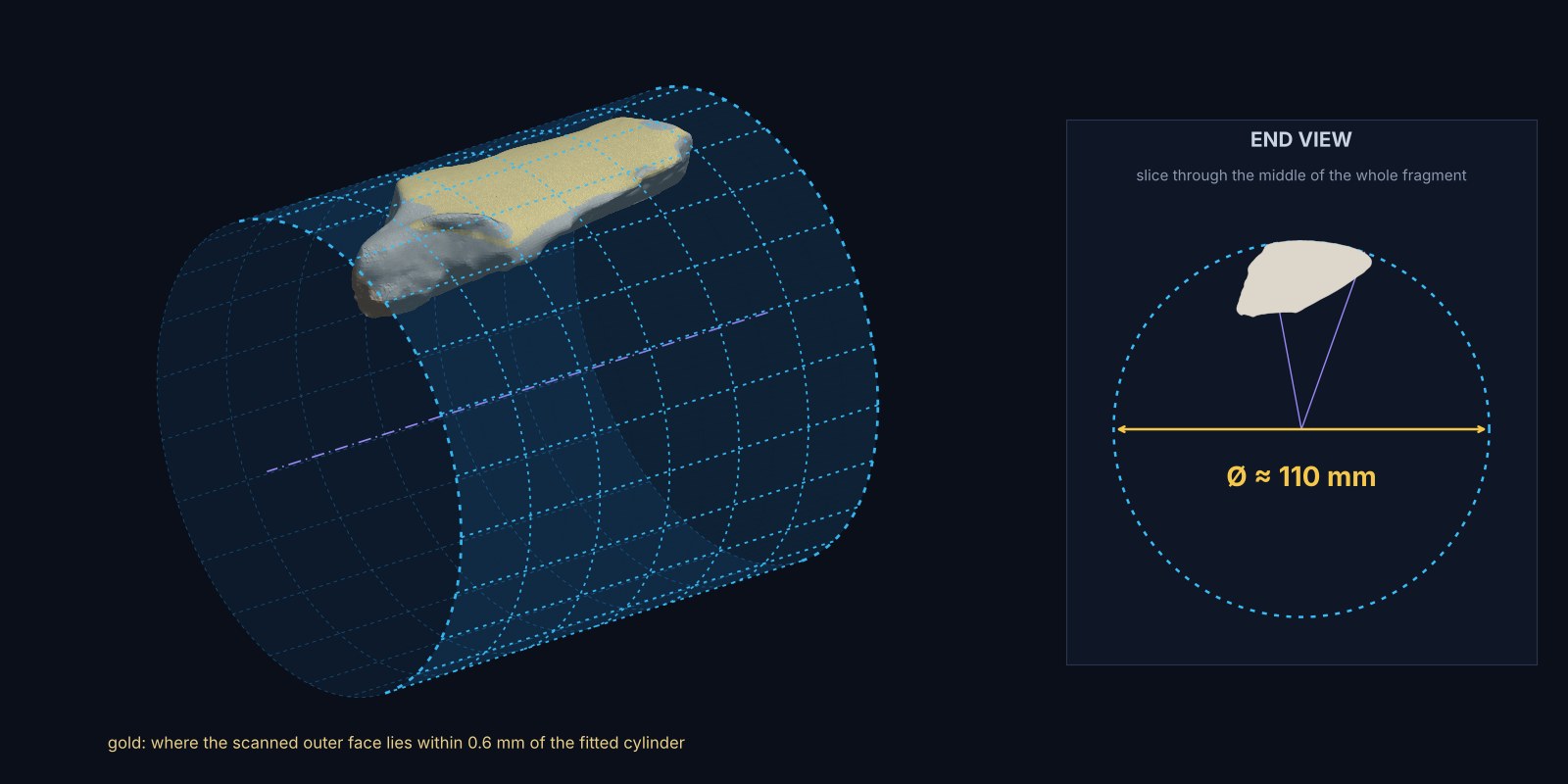
| Outer curvature | Measured three ways. Across a 38 mm chord, the outer face rises 2.8–3.2 mm (the sagitta), which gives a radius of 58–66 mm, or a shell diameter of about 116–132 mm (best estimate 123 mm). Radius gauges fit at 127 mm diameter at one end and 115 mm at the other. A full 3D scan of the whole fragment (October 24, 2026), both faces and all edges, fits the smooth central part of the outer face to a cylinder of 105–114 mm in diameter (best fit about 110 mm), with the surface following the cylinder to within 0.02–0.08 mm; over the same 38 mm chord that is a rise of about 3.3–3.6 mm. This confirms the earlier one-sided scan, which gave 103–114 mm. |
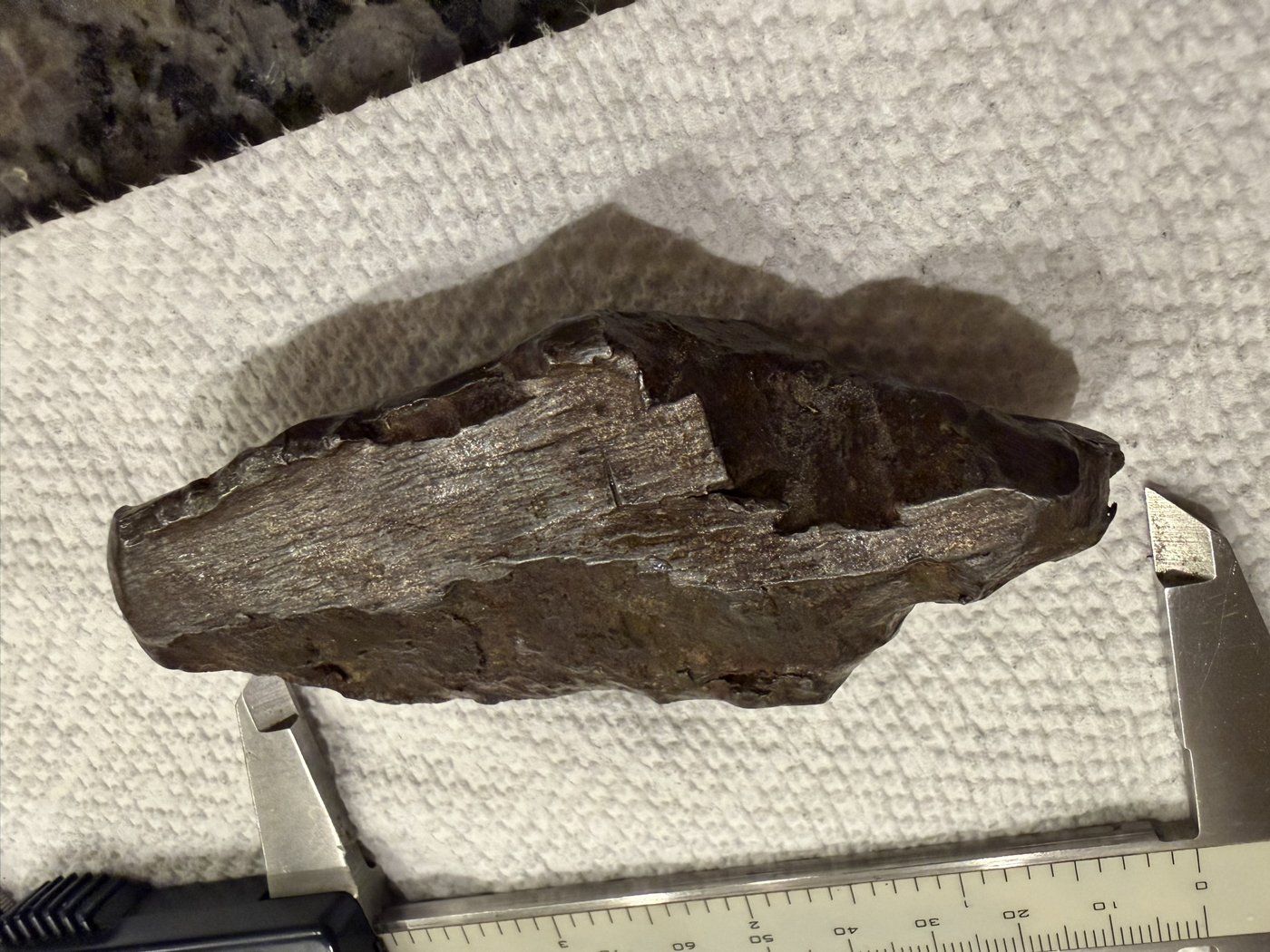
| Shape | Twisted along its length, which is why the two ends read differently, and the cylinder’s axis runs about 7–9° off the fragment’s long direction. The long edges are curled tighter than the middle, where the wall rolled as the shell burst. The inner face is too rough and irregular to fit a cylinder, so the scan cannot yet give an independent inner diameter. |
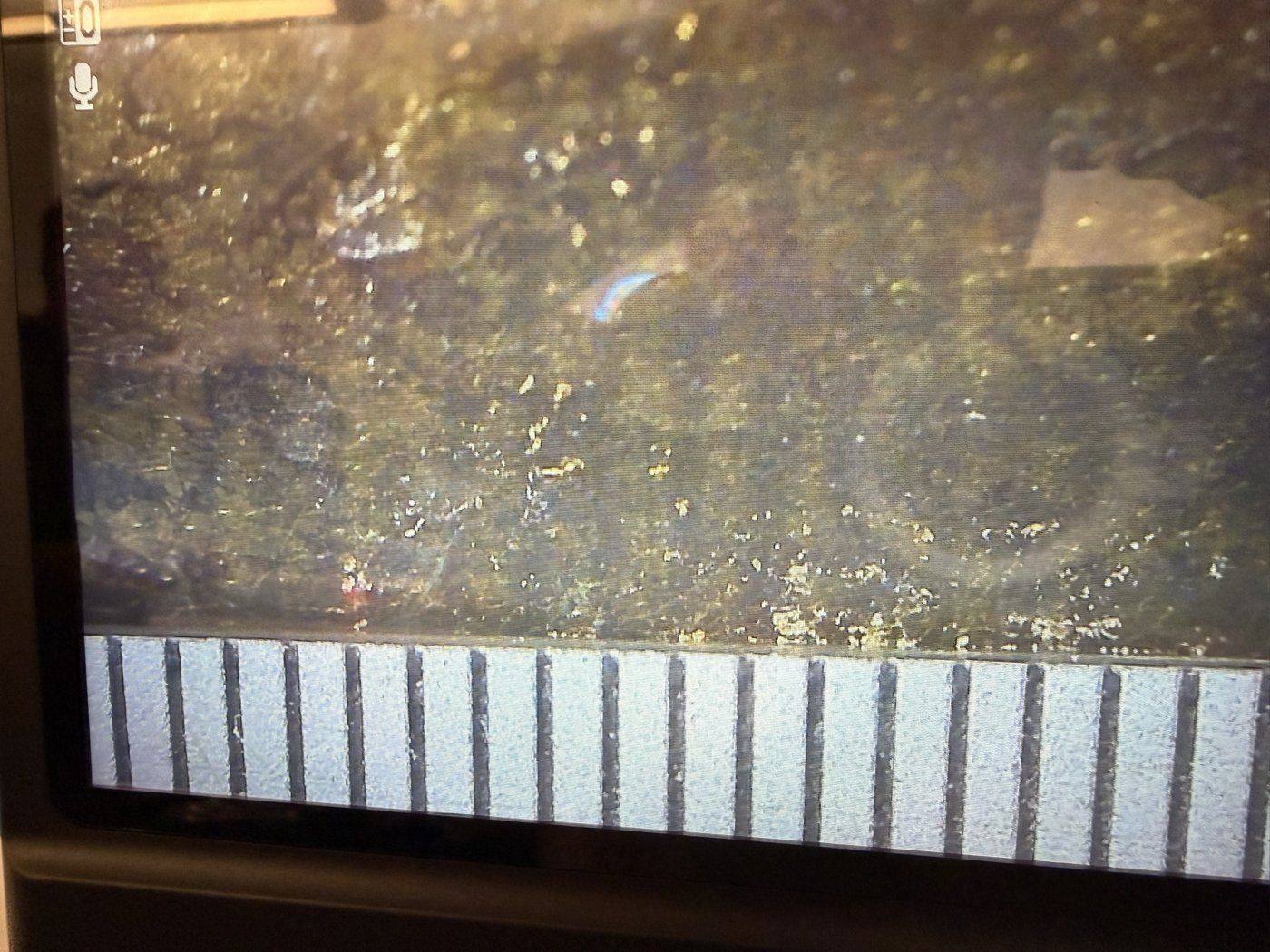
| Machining marks | Fine, evenly spaced tool marks running around the outside, about 0.39–0.43 mm apart (23 lines in 10 mm under the microscope), left by the lathe that turned the shell. |
| Scratch | One straight groove at 19–22° to the shell’s axis. That is too steep to be a rifling mark (rifling engraves at about 7°), so it is most likely a scrape from the impact. |
Whose shell was it?
The Corregidor Historic Society attributes the hit to Battery Monja, which the Japanese manned with a captured American 155 mm gun. The curvature of the fragment does not fit a shell that large. The table shows how much a 38 mm chord would rise on the outside of each candidate shell, compared with the 2.8–3.2 mm measured by hand and the 3.3–3.6 mm from the 3D scan.
| Shell | Rise over 38 mm, and fit |
|---|---|
| About 10 cm (100 mm) | 3.7 mm. Slightly tighter than even the scan, but close; a shell in the 10–10.5 cm class fits the scan better than any larger one. |
| About 11 cm (110 mm) | 3.4 mm. The scan’s best fit. |
| Japanese 12 cm (120 mm) | 3.1 mm. Fits the hand measurements; a little flatter than the scan. Japanese 12 cm dual-purpose and naval guns were widely used for coast defense. |
| U.S. 5-inch/38 (127 mm) | 2.9 mm. Fits the hand measurements but not the scan. This was the Fletcher’s own gun, and No. 1 mount and its handling room, with their ammunition, were right where the shell burst. |
| Japanese 12.7 cm (127 mm) | 2.9 mm. As for the 5-inch. |
| 6-inch / 155 mm | 2.4 mm. Does not fit any of the measurements. |
At the time, the Fletcher’s crew judged from the hole it punched through the deck that it had been roughly a 6-inch round. That estimate and the fragment can both be right: a shell tearing through deck plating usually leaves a hole noticeably larger than its own diameter.
Every measurement rules out the 155 mm gun. Beyond that, the evidence now pulls two ways. The hand measurements point to a shell of about 120–127 mm: a Japanese 12 or 12.7 cm shell, or one of the Fletcher’s own 5-inch shells broken up when the enemy shell burst among the No. 1 gun and its ammunition. Three 3D scans, the latest of the whole fragment, point a little smaller, to about 105–114 mm (perhaps up to 116 mm if the scan runs slightly small), which would favor a shell in the 10–11 cm class, a size used by several Japanese army guns.
The scans are the more precise measurement, but they cannot by themselves say how the burst changed the steel. If the burst flattened the middle of the piece, the original shell was smaller still; if it bent the piece tighter, the shell could have been a 5-inch after all. A fragment from the tapering nose of a shell would also curve more tightly than the shell’s full diameter, and the tilted axis leaves that possibility open. A metallurgical test of the steel, compared with known American and Japanese shell fragments, and the spacing of the lathe marks, are the most promising ways to settle it.
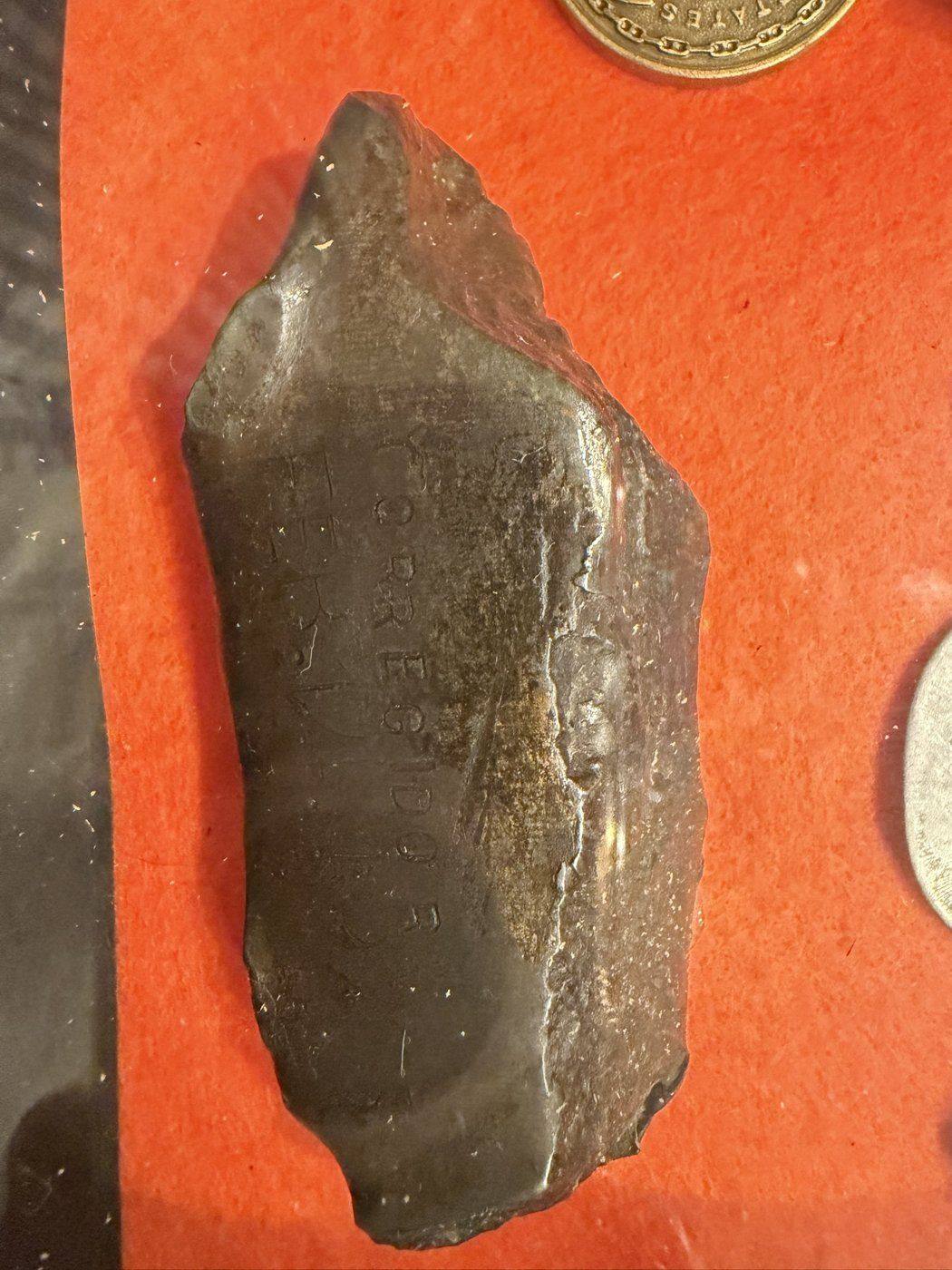
This is a work in progress. Three 3D scans have been made; the latest, a complete two-sided scan of the whole fragment, is shown above. It measures 99.1 mm at its longest, a little under the caliper’s 100.7 mm, so the scan may run about 1.5% small; if so, every diameter from it should be about 1.5% larger, putting the best fit near 112 mm. The scan’s volume, 43.4 cm³, means the fragment should weigh about 340 g if it is solid steel; weighing it will check the scan’s scale. Measurements of the steel are still to come. The family will make a replica of the fragment before offering the original to a museum.
Sources
- USS Fletcher Combat Action Report, Manila Bay Operations, 13–17 February 1945 (Serial 020).
- Corregidor Historic Society, on the Japanese use of Battery Monja.
- Measurements by Larry Knipp, 2026.
- Family recollections.